



by Zach Muhlbauer
During a summer composition course, a LaGuardia student learns their work has come under suspicion that it was written by AI. The instructor claims the student’s spoken and written English do not match and treats the paper as too composed, too clean to be their own. The student acknowledges revising their work with Grammarly, but fervently denies using AI to generate the paper and even offers to assemble version histories with tracked changes to prove it.
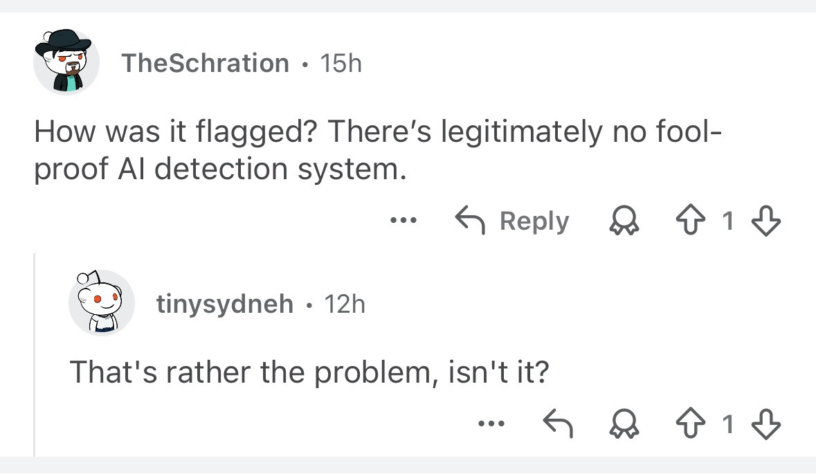
The LaGuardia exchange is not unusual. Across subreddits like r/HunterCollege, r/Baruch, r/QueensCollege, and r/CUNY, students instruct one another to document their writing process, share their detector scores, and prepare to explain their work aloud. One Hunter student worries that revising a long paper to satisfy an AI detector would make their writing less developed and mature. At Baruch, another student watches as their grade shifts from a WU to an F, with the professor, department chair, registrar, and dean all drawn into the case. Testimonials on Reddit underscore how AI suspicion shifts the burden of proof onto students, making authorship something they must defend when their writing has been algorithmically cast as suspect.
Plagiarism detection giants like Turnitin have long warped how students learn to write and under what conditions they see themselves as writers. More recently, though, the plot has thickened. On top of their usual offerings, these services now peddle AI detection solutions that claim to distinguish human-sourced writing from machine-generated output.
To grasp the problem with AI detection, take what one of those prominent services claims to do. GPTZero discloses two statistical metrics: “perplexity,” a measure of how well an LLM would predict each successive word in a passage; and “burstiness,” used to score variation in the sentence-level rhythm and structure of student writing. Both assume that human writers naturally vary syntax and sentence length, while large language models (LLMs) are considered more predictable with consistent, flat tempos at the sentence- and paragraph-level.
This premise is very shaky, if not wrongheaded, and points to why detection failures multiply at scale. Since detectors classify writing by proxy and rely on statistical signals to label a text as machine-generated, those signals track unevenly across language models, genres, revision practices, and linguistic differences, yielding probability scores that often break down when applied to actual student writing.
One of the most comprehensive accounts from the field tested twelve publicly available tools alongside Turnitin and PlagiarismCheck, reporting they were “neither accurate nor reliable,” and exhibited a systematic bias toward classifying AI-generated text as human-written. As one teaching center notes, even a “low” 1% false-positive rate across 22.35 million first-year college essays amounts to 223,500 essays falsely flagged in a single year.
Those affected are hardly edge cases. The MLA-CCCC Joint Task Force on Writing and AI put it plainly when it warned AI detection tools could enable “false accusations on students, including negative effects that may disproportionately affect marginalized groups.” In particular, Black teens are reported to be twice as likely as their white peers to receive AI-detection accusations, while neurodivergent students may also face heightened risks of false positives when their writing departs from the narrowed standards these tools inscribe as human.
Another study by Stanford researchers found that widely used detection services flagged as AI-generated 61.22% of TOEFL essays by non-native English speakers, and, across all seven detectors, 89 of 91 essays were flagged by at least one of the sampled tools in the study.
For all their alleged sophistication, AI detectors still classify writing through statistical signals that remain inconsistent across LLMs and easily disrupted by content obfuscation techniques. Their unreliability and the anxiety they produce are therefore hardly surprising. Such conditions follow from what detection services are built to do, which is to narrow the field of human writing to features an algorithm can count, weigh, and score.
The larger problem is that AI detection invites us to accept a hidden standard of human writing that is opaque and flattening and treats “authentic” prose as a fixed object or end product, concentrating suspicion on students whose language practices diverge from dominant models of human-like writing. In turn, their encoded “human” criteria define not an inherent quality of submitted writing but a mere rubric for evaluating prose; one that turns writing into a process under surveillance and assessment into automated verification rather than a responsive, context-aware teaching practice.
Trust is hard work in any classroom, and AI detection only makes it harder. Such detection papers over the notion that, as a service, it offers little more than a problem dressed in its own solution, a classic case of what Evgeny Morozov calls solutionism, which “presumes rather than investigates the problems that it is trying to solve” (6).
As for the LaGuardia student, their instructor cleared the paper of all charges—but not without warning them about Grammarly, and as it happens, the thesaurus too.
Note: Reddit data used in this post (e.g. usernames, wording, dates, and identifying details) have been disguised to protect student privacy and reduce doxxing risk.
Zach Muhlbauer is a PhD Candidate in English and a Teaching and Learning Center Fellow.
References
“Why Don’t AI Detectors Work?” Center for Integrated Professional Development, Illinois State
University, 2024, https://prodev.illinoisstate.edu/instructional-resources/pedagogy/ai/detectors/. Accessed 5 Feb. 2026.
“AI Detectors Biased Against Non-Native English Writers.” Stanford HAI, Stanford University, 15 May 2023, https://hai.stanford.edu/news/ai-detectors-biased-against-non-native-english-writers. Accessed 5 Feb. 2026.
Eaton, Sarah Elaine. “Neurodiversity and Academic Integrity: Toward Epistemic Plurality in a Postplagiarism Era.” Teaching in Higher Education, 3 Nov. 2025, pp. 1–20, https://doi.org/10.1080/13562517.2025.2583456.
Cheng, Adam, et al. “Ability of AI Detection Tools and Humans to Accurately Identify Different Forms of AI-Generated Written Content.” Advances in Simulation, vol. 10, no. 66, 22 Nov. 2025, https://doi.org/10.1186/s41077-025-00396-6.
Galczynski, Jordan. “The Imperfection of AI Detection Tools.” HumTech, UCLA, 9 Oct. 2025, https://humtech.ucla.edu/technology/the-imperfection-of-ai-detection-tools/. Accessed 7 Feb. 2026.
Hirsch, Amanda. “AI Detectors: An Ethical Minefield.” Center for Innovative Teaching and Learning, Northern Illinois University, 12 Dec. 2024, https://citl.news.niu.edu/2024/12/12/ai-detectors-an-ethical-minefield/. Accessed 5 Feb. 2026.
Liang, Weixin, et al. “GPT Detectors Are Biased Against Non-Native English Writers.” Patterns, vol. 4, no. 7, 14 July 2023, p. 100779, https://doi.org/10.1016/j.patter.2023.100779.
Madden, Mary, et al. “The Dawn of the AI Era: Teens, Parents, and the Adoption of Generative AI at Home and School.” Common Sense Media, 18 Sept. 2024, https://www.commonsensemedia.org/sites/default/files/research/report/2024-the-dawn-of-the-ai-era_final-release-for-web.pdf.
“MLA-CCCC Joint Task Force on Writing and AI. Overview of the Issues, Statement of Principles, and Recommendations.” Working Paper 1, July 2023, https://aiandwriting.hcommons.org/.
Morris, Sean Michael, and Jesse Stommel. “A Guide for Resisting Edtech: the Case against Turnitin.” Hybrid Pedagogy, June 2017, https://hybridpedagogy.org/resisting-edtech/.
Morozov, Evgeny. To Save Everything, Click Here: The Folly of Technological Solutionism. PublicAffairs, 2013.
Sadasivan, Vinu Sankar, et al. “Can AI-Generated Text Be Reliably Detected?” Transactions on Machine Learning Research, Jan. 2025, https://doi.org/10.48550/arXiv.2303.11156.
Tian, Edward. “Perplexity, Burstiness, and Statistical AI Detection.” GPTZero, 1 Mar. 2023, https://gptzero.me/news/perplexity-and-burstiness-what-is-it/. Accessed 5 Feb. 2026.
Weber-Wulff, Debora, et al. “Testing of Detection Tools for AI-Generated Text.” International Journal for Educational Integrity, vol. 19, no. 26, 2023, https://doi.org/10.1007/s40979-023-00146-z. Accessed 28 Feb. 2026.

This entry is licensed under a Creative Commons Attribution-NonCommercial-ShareAlike 4.0 International license.




Leave a Reply